Anthropic is rolling out an integration between Claude Code and Slack, allowing developers to trigger coding tasks directly from team conversations.
While the feature is launching in beta for now, the move reflects a broader shift in how software teams interact with AI tools, with collaboration platforms serving as the starting point for development work.
Indeed, countless engineering discussions related to bugs, feature requests, and design changes already take place in team chat tools, with Slack a key coordination layer for day-to-day development. With this latest integration, developers can tag Claude in an ongoing conversation where an issue has been reported, and have the assistant interpret the surrounding context as a coding task. That can include messages from customer support, snippets from logs, or early observations about unexpected behavior in production.
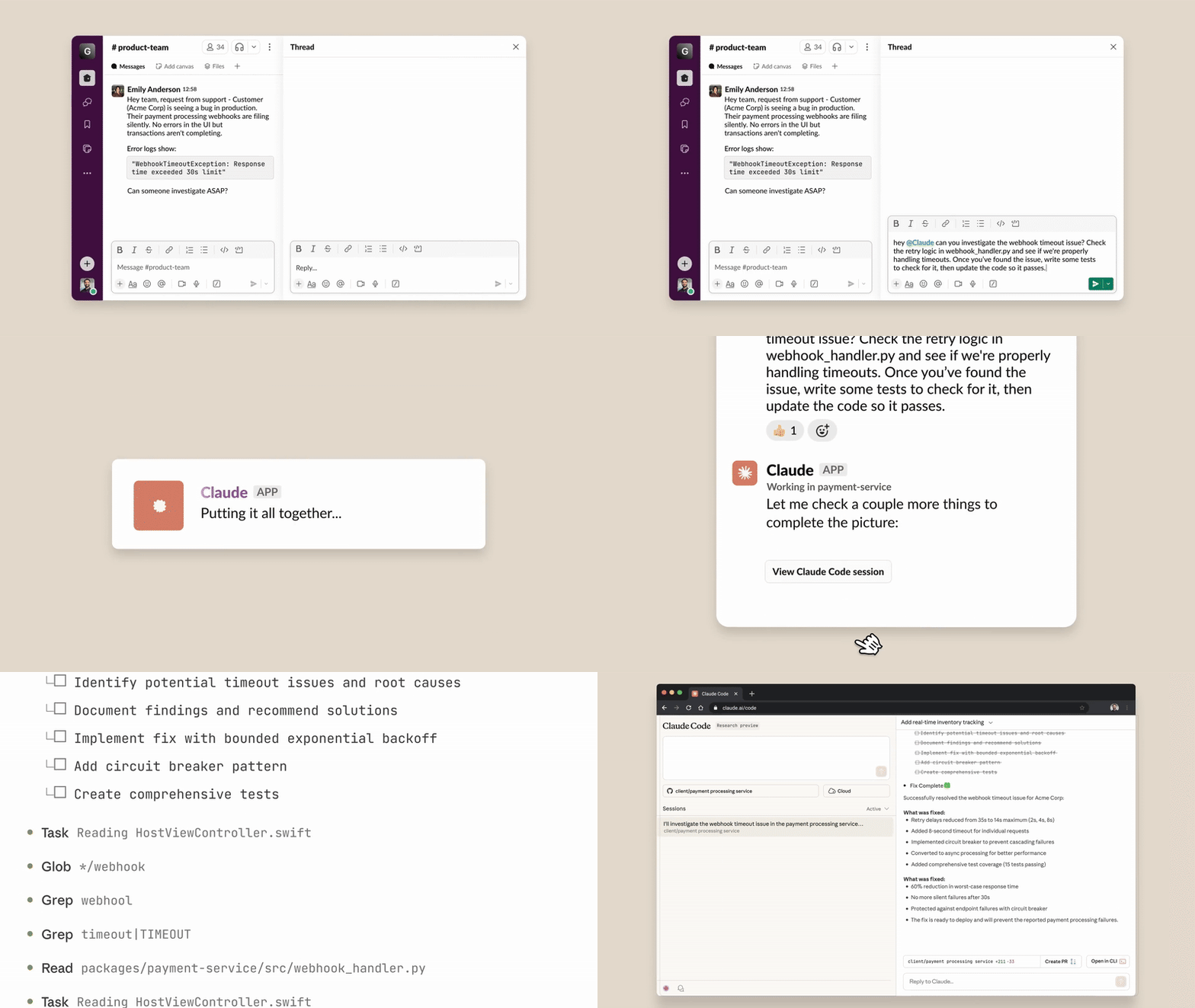
So, rather than requiring users to extract that information and paste it into an IDE or separate interface, Claude uses the thread itself to determine what needs investigating and spins up a Claude Code session on the web. As work progresses, the assistant posts updates back into Slack, allowing the rest of the team to follow along. When the task is complete, Claude returns with a summary of the work and a link to open a pull request, keeping the activity grounded in the original conversation.
The integration builds on the existing Claude app for Slack, which already allows users to interact with Claude directly in channels and threads for general assistance. With the Claude Code integration in tow, those conversations can now be treated as entry points for full coding workflows rather than standalone chat interactions.
Accessing Claude Code in Slack requires the Claude app to be installed and a Claude account linked to a Pro, Team, or Enterprise plan.
Claude Code’s move into Slack aligns with a wider industry trend in which chat platforms are becoming tightly coupled with AI-powered development tools. GitHub has taken a similar approach by bringing Copilot into Microsoft Teams, while OpenAI’s Codex also includes a native Slack integration that lets teams delegate tasks or ask questions directly from Slack threads. Cognition’s Devin, meanwhile, is built around Slack as a primary interface.
Together, these efforts point to a future where the boundary between “talking about code” and “writing code” diminishes. AI assistants are no longer confined to IDE sidebars or standalone web apps; they are being embedded directly into the tools teams already use to coordinate work.
The idea of Slack becoming a coordination layer for AI agents has been echoed by Slack itself. In a recent AI Native Dev podcast, Samuel Messing, Slack’s VP of Engineering for Search and AI, discussed how the company’s AI strategy is built around leveraging the messages, threads, and shared files already present in Slack as core context, a framing that closely mirrors how tools like Claude Code are now being positioned.
A portion of the community reaction so far has focused on what such an integration suggests about the changing role of the IDE in modern development workflows. One LinkedIn member argued that as coding agents become more capable, the point at which work begins is shifting away from the IDE and toward planning and coordination tools, with engineers increasingly stepping in later in the process to review and validate outcomes.
“The need to go to an IDE and make changes is diminishing day by day,” they wrote. “Now PMs write a detailed JIRA ticket and coding agents take care of the rest.”
Related to this, another commenter pointed to reduced context switching as a key driver of that shift, suggesting that keeping coding workflows anchored in team communication tools helps preserve discussion context that is often lost when work moves into an IDE.
“The integration of Claude Code with Slack could significantly streamline development workflows by reducing context switching,” they wrote. “As a project manager, I can see how routing coding tasks through existing communication channels would allow teams to address bugs more efficiently while preserving crucial discussion context.”
These perspectives reinforce the notion that while the IDE remains essential, its role is shifting — from the central hub of all development activity to one component in a broader, chat-driven workflow.
Reactions weren’t universally positive, however. Some practitioners cautioned that while conversational coding promises speed and convenience, they may introduce new risks when applied to complex or mission-critical systems.
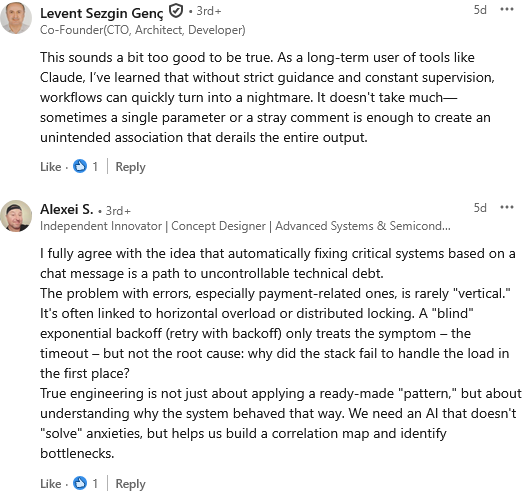
“This sounds a bit too good to be true,” one user wrote. “As a long-term user of tools like Claude, I’ve learned that without strict guidance and constant supervision, workflows can quickly turn into a nightmare. It doesn't take much—sometimes a single parameter or a stray comment is enough to create an unintended association that derails the entire output.”
Another commenter took issue with the idea of automatically resolving critical system failures based on conversational input alone, arguing that many real-world errors — particularly in areas like payments — are rarely isolated to a single line of code. Instead, they tend to emerge from broader systemic issues such as load, contention, or distributed coordination, where treating surface symptoms can obscure deeper architectural causes.
“I fully agree with the idea that automatically fixing critical systems based on a chat message is a path to uncontrollable technical debt,” they said.
Put another way, while chat-driven coding agents may accelerate routine tasks and reduce friction in day-to-day development, some users remain wary of extending those workflows too far into high-stakes systems, where speed without deeper understanding can introduce risks that are harder to unwind.