11 Dec 20257 minute read

11 Dec 20257 minute read
Mistral, the French frontier AI model lab most recently valued at €11.7 billion, has launched a duo of open-weight coding models alongside a new terminal-based open source agent.
Devstral 2, as the fresh family of coding models are called, comes in two distinct flavours: the flagship Devstral 2, a 123-billion-parameter model aimed at large-scale engineering work, and Devstral Small 2, a 24-billion-parameter variant designed for local or resource-constrained environments.
Both models are released as open-weights under permissive licences.
Where these models differ from many existing coding assistants is their explicit focus on enterprise-grade software engineering. According to Mistral, Devstral 2 is built as an “enterprise-grade text model that excels at using tools to explore codebases, editing multiple files and powering software-engineering agents.”
This is similar in some ways to the inaugural Devstral model launched back in May, which introduced Mistral’s first agentic coding system built to solve real GitHub issues and run efficiently on a single GPU. But the new generation marks a clear shift in scale and ambition: Devstral 2 moves from a lightweight, locally focused assistant to an emphasis on long-context reasoning, structured tool use, multi-file modifications and predictable step-by-step behaviour — features intended for production workflows.
The smaller incarnation, meanwhile, is designed to bring most of the same capabilities into environments where compute or privacy constraints rule out reliance on an API. Devstral Small 2 is calibrated for on-device or local-cluster deployment, making it a plausible option for companies that want agentic automation inside their own infrastructure rather than through a cloud endpoint.
Building on this, Vibe CLI is Mistral’s attempt to put these models directly into the developer’s daily workflow rather than behind an IDE plugin or proprietary wrapper. The tool runs in the terminal and reads the project’s real structure — file trees, Git history, configuration files and the surrounding context — before executing changes. Instead of offering isolated code completions, it acts as a command-aware assistant that can propose, apply and explain multi-file edits while keeping developers in full control of what gets written to disk.
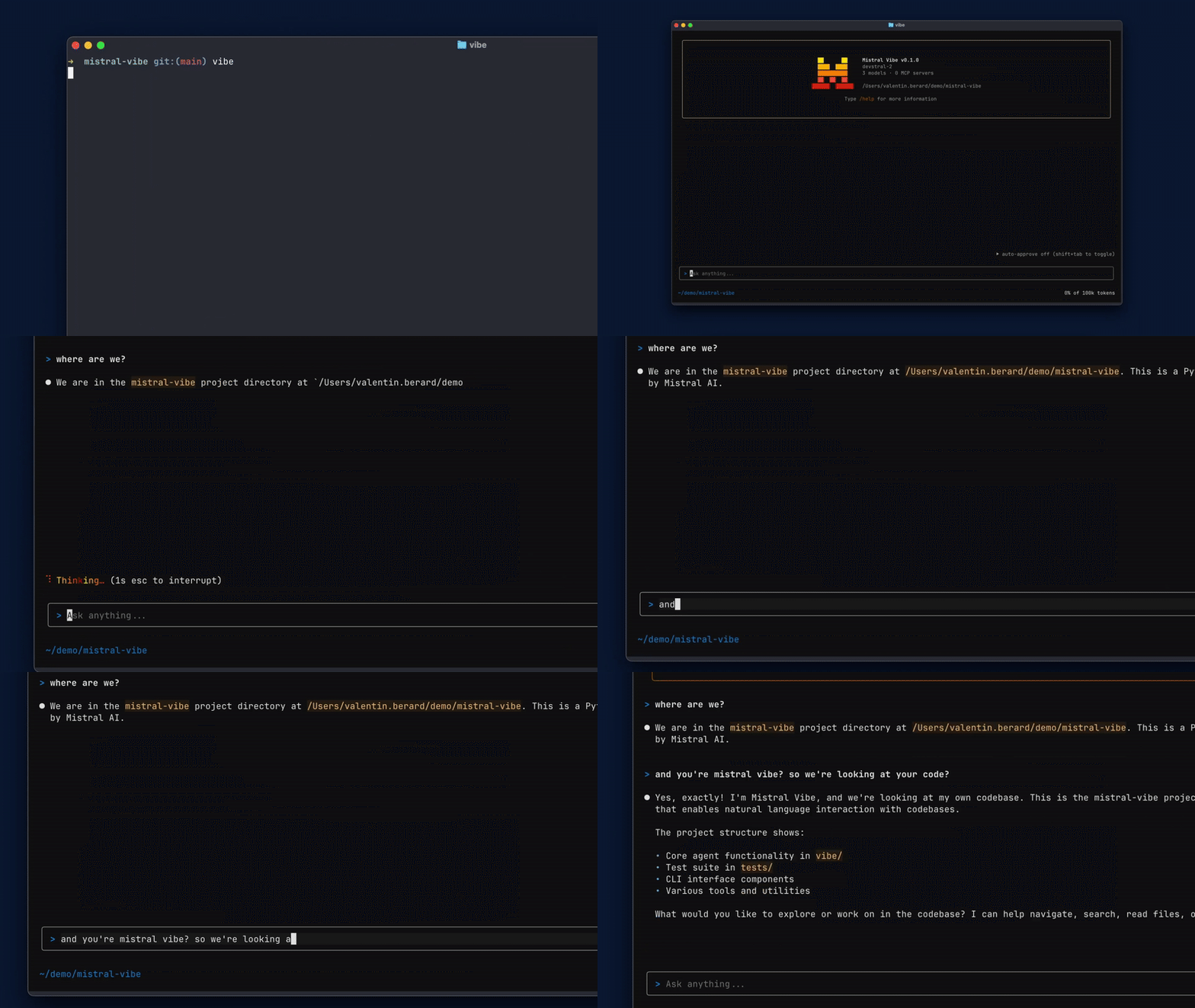
This command-line tool also integrates with editors such as Zed via the Agent Communication Protocol, meaning it can step between the terminal and GUI environments without losing context. Permissions, tool execution and model selection are all exposed visibly, and the CLI is fully open source under Apache 2.0, allowing teams to inspect, modify or extend its behaviour.
On pricing, Devstral 2 is currently free to use via the API, with standard billing expected to take effect after the launch window. When pricing does resume, the model will be billed at $0.40 per million input tokens and $2.00 per million output tokens, while Devstral Small 2 will cost $0.10 / $0.30 respectively. For now, the temporary free-access period is intended to encourage broad testing and early integration.
Devstral 2’s arrival follows some 10 days after a curious detour in the broader community: in early December, open source coding agent Kilo Code quietly surfaced access to a stealth Mistral model dubbed Spectre — a pre-release version of what was later confirmed to be Devstral 2. Spectre appeared inside Kilo Code’s model selector, and was offered free with no usage caps, giving developers early hands-on experience with a 256K-token, agent-oriented model while Mistral’s new family was still under wraps.
That early testing informed some of the expectations and practical constraints baked into Devstral 2 as it launched publicly with broader tool support and enterprise positioning.
“It was one of our most successful stealth launches yet, surpassing 17B tokens used by our community in the first 24 hours alone,” Kilo Code CEO Scott Breitenother wrote on social media.
Early performance data highlights the models’ emphasis on complex, real-world coding tasks.. Mistral reports that Devstral 2 achieves 72.2% on the SWE-Bench Verified benchmark — a curated, human-validated subset of software-engineering tasks — with Devstral Small 2 hitting 68%.
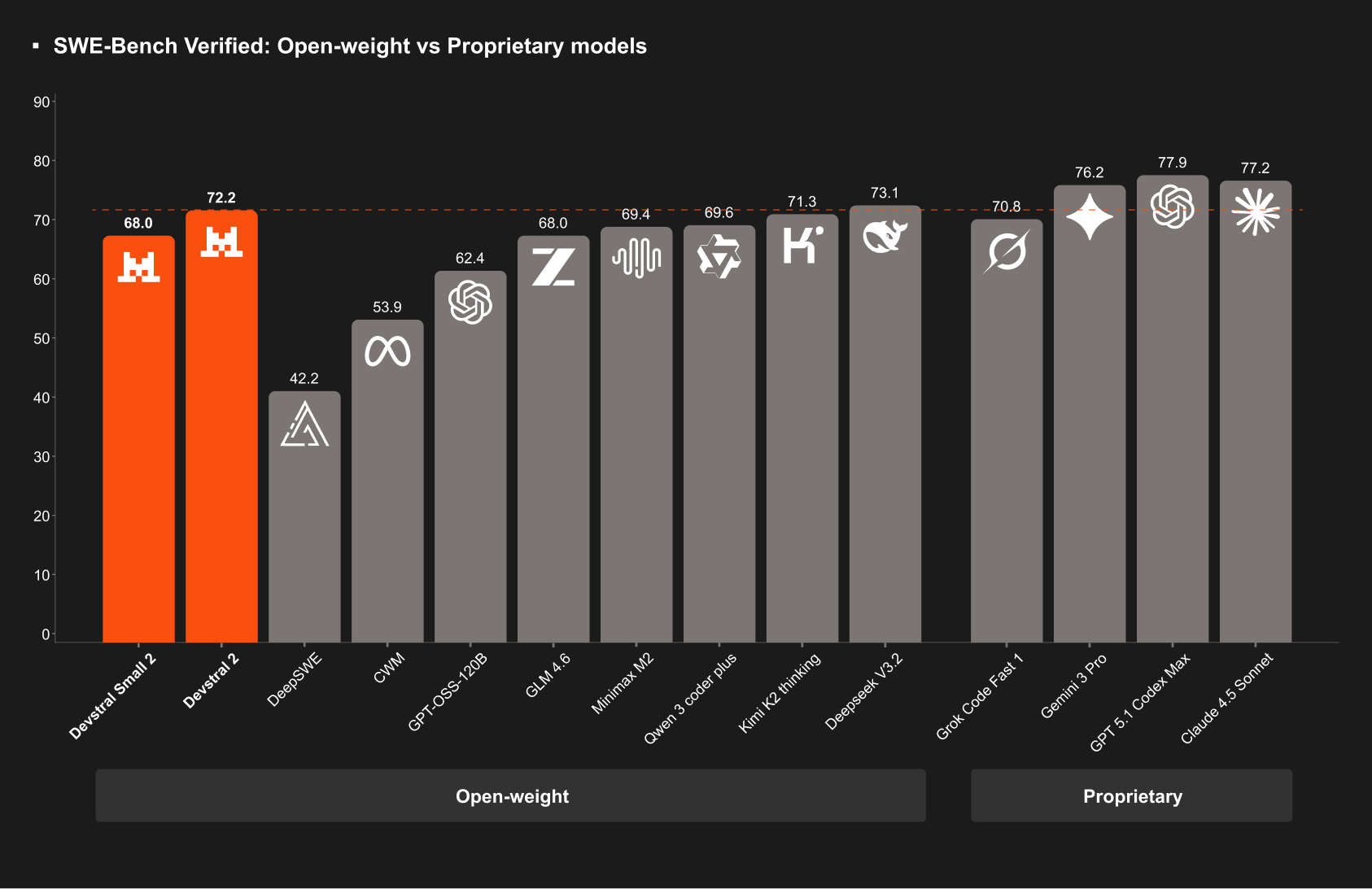
These figures would place the models among the strongest open-weight coding systems evaluated to date. However, the results don’t yet appear on the public SWE-Bench leaderboard, which only lists models officially submitted through its verification pipeline.
Early feedback was mixed but fairly fervent, particularly around the arrival of an open source CLI agent. One Reddit user said: “I was literally looking at that today and just couldn't get my head around why there was not one good open source CLI agent, Bravo\! I love it even more that it is you guys bringing it to the community. Love mistral and the mission, we only use your models in our company!”
Others offered more practical, hands-on impressions. After several hours with Devstral Small 2, one commenter reported being “very impressed,” though they noted clear limits outside its coding strengths.
“I’m able to run it with 64k context in combination with Kilo Code,” the user wrote. “Absolutely my new go-to model. Totally worthless in terms of multi-language support and generating text tho, but that's to be expected. Would be interesting to see if the 123b model would be able to at least generate 1 paragraph of Dutch text for example without mistakes.”
For developers wanting to experiment, both Devstral models are available through the Mistral API and from Hugging Face for local execution. The Vibe CLI agent can be installed directly from its GitHub repository, offering a straightforward way to try the new models inside a terminal workflow.

23 Jul 2025
10 Dec 2025

5 Jun 2025

9 Dec 2025