23 Dec 20258 minute read

23 Dec 20258 minute read
As large language models (LLMs) become embedded in developer tooling, attention is swinging from pure capability concerns to more operational characteristics, such as latency, cost, and how these models behave when they are invoked repeatedly in real systems.
Google’s Gemini 3 Flash reflects that shift, designed for high-throughput, low-latency use. The launch comes roughly a month after Google first introduced the Gemini 3 family, kicking off with Gemini 3 Pro as its most capable general-purpose model. Flash continues a pattern seen in earlier Gemini releases, where Google positions faster variants for tasks that involve frequent model invocation across day-to-day software systems.
At a technical level, Gemini 3 Flash targets long-running, tool-driven workflows. The model supports up to 1 million input tokens and can generate outputs of up to 64,000 tokens, while accepting multimodal inputs including text, images, video, audio, and documents.
Such characteristics shape how often a model needs to be called to complete a task, which is where cost becomes relevant. In Google’s published pricing, Gemini 3 Flash is listed at $0.50 per million input tokens and $3 per million output tokens, compared with around $2 and $12 per million respectively for Gemini 3 Pro at comparable tiers. In tools that invoke models repeatedly — such as chat interfaces, agents, or automated code search — those per-token differences can accumulate quickly, making pricing a practical consideration alongside performance.
Google’s published benchmarks position Gemini 3 Flash across a range of developer-focused evaluations, with seemingly strong results on reasoning and knowledge benchmarks such as GPQA Diamond and AIME 2025, alongside software-focused tests including SWE-bench Verified.
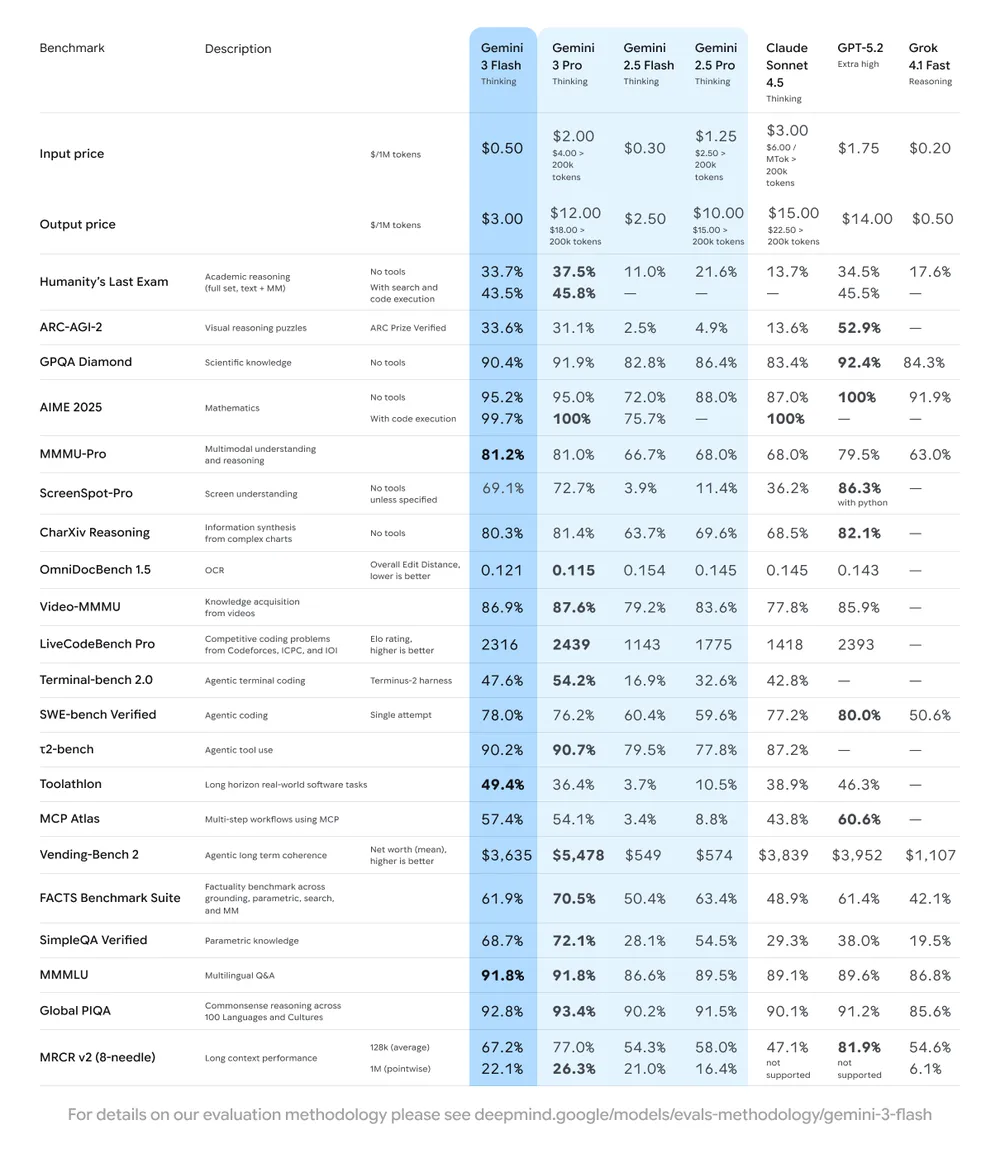
Results on agent- and tool-oriented benchmarks, such as Terminal-Bench and MCP Atlas, suggest the model is capable of handling multi-step workflows that involve tool use and stateful execution.
It’s worth noting that these figures are published by Google, and like most launch benchmarks will depend on the company’s own evaluation setup and inference settings. Benchmarks remain an imperfect proxy for production workloads, but once a model is accessible through an API — as Gemini 3 Flash is — external teams can run their own evaluations under comparable conditions.
One notable detail in Google’s benchmark table is the absence of Claude Opus 4.5, the coding-focused model Anthropic released in late November. Make of that what you will – Google doesn’t comment on the omission, but it may reflect the timing of Opus 4.5’s availability relative to when the evaluations were conducted.
Gemini 3 Flash is already rolling out across both Google’s developer and consumer-facing platforms. On the developer side, it’s available in preview via the Gemini API through Google AI Studio, Vertex AI, Gemini Enterprise, and tools such as Gemini CLI and Android Studio. It’s also available in Antigravity, Google’s recently-introduced agentic IDE.
On the consumer side, Google is making Flash the default model in the Gemini app and adding it to AI Mode in Search.
However, the model is already starting to appear in third-party developer tools, offering early signals of how it behaves in real workflows. Amp, the AI coding agent that recently spun out of Sourcegraph, is using Gemini 3 Flash in its codebase search sub-agent, replacing Anthropic's Claude Haiku 4.5. According to Amp, the switch reflects improvements in how Gemini 3 Flash handles parallel tool calls and exploratory queries, allowing searches to converge in fewer iterations and complete more quickly.
JetBrains has taken a similar step, making Gemini 3 Flash the default model in both JetBrains AI Chat and its Junie agentic coding assistant, extending Flash’s reach into one of the most widely used IDE environments. The company says the change reflects internal evaluation results around performance and operational fit in production settings.
“In our JetBrains AI Chat and Junie agentic-coding evaluation, Gemini 3 Flash delivered quality close to Gemini 3 Pro, while offering significantly lower inference latency and cost,” JetBrains’ head of AI DevTools ecosystem Denis Shiryaev said. “In a quota-constrained production setup, it consistently stays within per-customer credit budgets, allowing complex multi-step agents to remain fast, predictable, and scalable.”
Discussion around the release touched on Gemini 3 Flash’s configurable reasoning depth and how that affects cost and runtime behavior in practice. Andriy Burkov, a machine learning researcher and author of The Hundred-Page Machine Learning Book, pointed to those trade-offs.
“Gemini 3 Flash seems to kick ass – it beats not just Gemini 2.5 Flash, but also Gemini 2.5 Pro on all benchmarks,” he said on LinkedIn. “I like that it has very flexible ‘thinking’ options compared to the Pro version: minimal, low, medium, and high. The Pro version only has low and high. The thinking tokens add a lot to the inference cost, and the process slows down incredibly as well.”
However, many users were a bit more cautious in their early reactions, with much of the discussion centered on the published benchmark scores.
“When benchmarks stop being jokes, that's when you know the plot just twisted,” one commenter noted. “Still want to test this on some edge cases – benchmarks tell part of the story,” said another.
Google’s decision to omit Claude Opus 4.5 from the comparison table also drew scrutiny.
“Claude Opus 4.5 instead of Sonnet should be included in that ranking,” one user wrote. “In other benchmarks, Opus beats even Gemini 3 Pro High.”
Burkov pushed back on that criticism, pointing out that the models occupy different market segments. In his view, comparing Gemini 3 Flash directly against Opus overlooks the substantial gap in pricing and intended use, with Opus positioned as a significantly more expensive model aimed at a different class of workloads.
Taken together, the skepticism doesn’t dispute that Gemini 3 Flash performs well on paper. Instead, it reflects a familiar pattern in model releases: early benchmark enthusiasm followed by calls for broader, real-world validation before teams commit to production use.